Showing posts with label February. Show all posts

Friday, 23 March 2018

February’s been hard on a heart

Candlemas Day used to have great significance in the rural calendar because the date lies halfway between the winter solstice and the spring equinox, so it marked the day upon which winter was half over. It was a time of the year which naturally formed a transition period in winter, a sense we were moving on into brighter and better days.

An ancient Scottish rhyme :

If Candlemas day be dry and fair, the half o’ winter to come and mair

If Candlemas’s day be wet and foul, The half o’ winter gane at Yule

It meant that if it was nice on Candlemas Day, 6 more weeks of yucky, winter weather was on the way. If it wasn’t nice on Candlemas Day, the weather should get nicer. A sort of Catch 22 weather. This photograph was taken on that day. Be afraid…be very afraid Smile

Coventry - February

Around the university grounds, pockets of Snowdrops were popping here and there. They were known as Candlemas Lilies and Candlemas Bells and a welcome assurance that the brighter days of spring were on their way. In the language of flowers, the Snowdrop was synonymous with ‘hope’ as it bloomed in early springtime, just before the vernal equinox, and seen as heralding the new spring and new year. In British folklore, they symbolised hope and purity. But the bulbs were poisonous which led to the superstition that a single bloom in a house represented death.

Slimbridge WWT - December

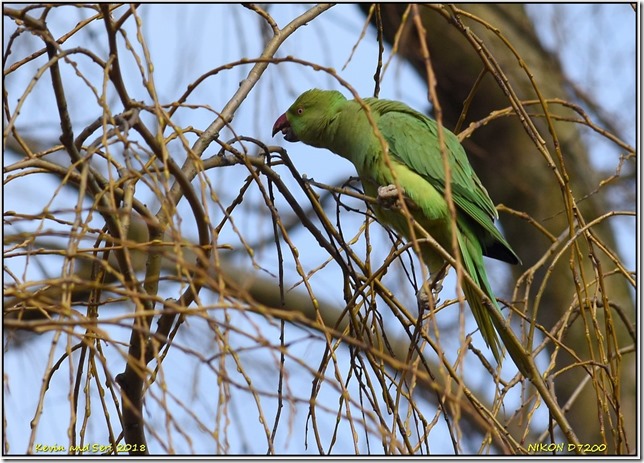
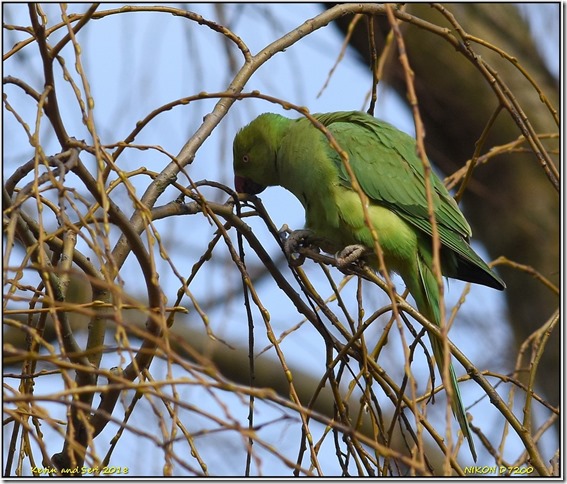
We made another visit to Longford Community Nature to see what the Ring-necked or Rose-ringed parakeets were up to. Thankfully, it turned out to be a sunny day and we hoped they would be out in the open. We headed straight to their patch on the Weeping Willow with the branches drooping over the River Sowe. These deciduous tree were often found near lakes and ponds and planted in parks and gardens due to their ornamental morphology. Raindrops that were falling to the ground from the drooping branches resembled tears and that was how the tree got its name.

Coventry - February

Their shrill screeching calls gave away their presence.  We looked up and they were chilling out deep among the twisted branches and twigs which was void of leaves. Again, they were playing hide-and-seek with us and when they found out that we weren’t going anyway, came out to play. From our observations and reading, we think that this family consisted of 2 adults and 2 juveniles. The male developed a thin black ring round his neck which ran from his throat, becoming thinner on the sides of the neck where it ran into a light coloured collar on the nape of his neck. The ring developed by about 17 months old and the male was usually sexually mature by age 3, a year later than the female.

Coventry - February

Coventry - February

The female and juveniles either showed no neck rings, or display shadow-like pale to dark grey neck rings. Bedecked with emerald green feathers and rose-red beak, the family brought a touch of tropical glamour to the park. One was seen speeding through the skies with its stream-lined body, pointed wings and long tail, so graceful and elegant in a brilliant green whirl. It was magnificent in flight. Unfortunately, it was just too fast to photograph.

Coventry - February

Coventry - February

Yellow catkins were appearing on the trees and in spring, the twigs and branches will be covered with the lance-shaped leaves. These catkins were important for producing an early source of nectar and pollen for bees and insects and we saw the Parakeets feeding on them. They also fed on a variety of fruits, berries, nuts, seeds, grains and household scraps. I am sure they were frequent visitors to the bird tables and garden feeders from the houses that bordered the park.
Coventry - February

Coventry - February

Native to Africa and Asia, Ring-necked parakeets were now thought to have one of the fastest-growing bird populations in the UK, estimated to more than 32K individuals at the end of the breeding season. These free-living parakeets were descended from multiple large releases into the wild, leading to a genetically healthy population with rapid growth rates. They evolved to tolerate a cold niche due to their ancestral origins in Northern India and was believed to have the potential to be ‘the grey squirrels of the skies.’This was because the mushrooming numbers might displaced other hole nesting birds such as the woodpeckers and nuthatches.

Coventry - February

Coventry - February

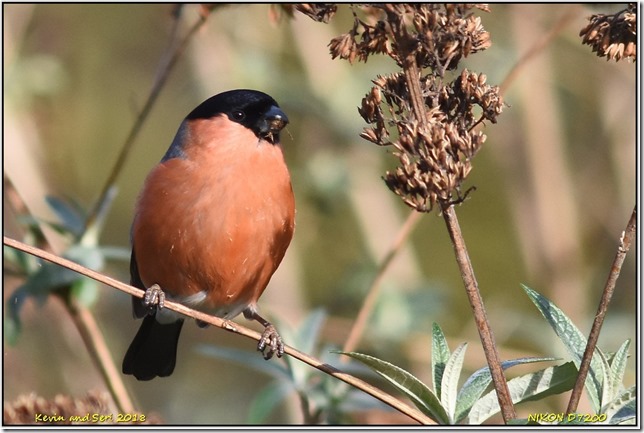
We also popped over to our favourite playground when we found out that flocks of Bullfinches were feeding on the seeds from the dried heads of the Buddleia flowers. In summer, with its purple, golden-eyed flowers full of fragrant glory and was a butterfly and bee paradise as they were an important nectar source. No other plant was such a magnet to them. We had photographed Tortoiseshells. Peacocks, Red Admirals, Whites, Brimstone and other species feasting on them. Buddleias provided nectar and pollen to bees and other insects. On warm nights, moths took their turn. And now, in deep winter, it was the turn of the Bullfinches. What a versatile plant. We’d 3 in our garden and they were always bedecked with glorious blossoms, butterflies and buzzing bees. Let’s raise a glass to the 17th century botanist and Essex clergyman after whom the shrub was named, the Reverend Adam Buddle.
Brandon Marsh - February

Bullfinches were striking birds. The name was said to describe the bull-like appearance with their compact, neckless body and short, deep bill. In Victorian times, they were desired captive birds due to their beautiful plumage and calls. It was believed that the caged bird could be trained to mimic music and it became a popular pastime to play a special flute to the birds. Their call note was a low, piping ‘deu-deu’, while the song was highly variable, quiet in nature and audible at short distances and was often described as ‘mournful’.

Brandon Marsh - February

The male Bullfinch was unmistakable with his bright pinkish-red breast and cheeks, grey back, black cap and tail with a bright white rump. The female had a brown back and pinkish-fawn underparts. They formed strong, lasting pair bonds and it was usual to see them in pairs all year round. In winter, the resident population was joined by ‘northern’ bullfinches from northern Europe. This pair were feeding voraciously on the seed-heads and because of their huge appetite were once ‘a pest’ of fruit crops.

Brandon Marsh - February

We were surprised not to see any Robins harassing us for food when we walked along the path. Perhaps the weather was much better and there were plenty of food around. But we saw one who was busy singing. The sound of a Robin chirping in winter was a good sign. It meant the bird had built up enough fat reserves to survive the cold nights and had enough energy left to defend its territory. Robins traditionally sings in spring to attract a mate, but in winter, when food was short, it faced a dilemma. Should it spent its time hunting for food to get through the next cold snap or burst into a song? Choices…choices. We helped by leaving a large mound of mealworms on the ground.

Brandon Marsh - February

We made a pit stop at Baldwin Hide but there was nothing much about. As soon as we got out the door, a family of Long-tailed tits had just landed on the tree near the hide. We watched this cute bundle of fur showing off its acrobatic skills as it gleaned invertebrates from the branches and from under the leaves. The tail was the most remarkable feature of this very tiny bird, and accounted for more than half of its total length. During its short, undulating flights, the tail dipped up and down. The flock moved in rapid surges through the tree in restless waves.

Brandon Marsh - February

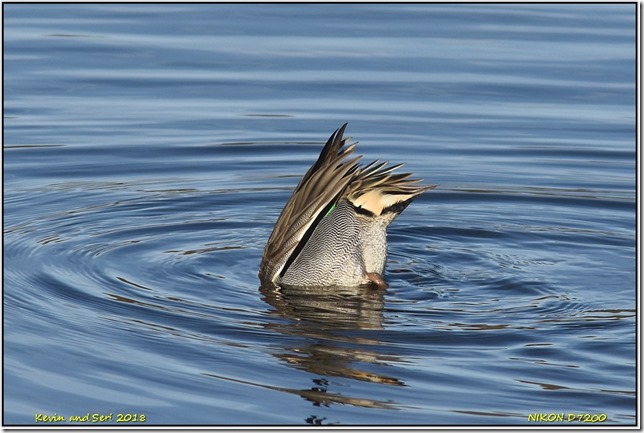
At East Marsh Hide, a pair of Gadwall was swimming quite close to the hide. They were grey-coloured with an obvious black rear end. When seen close up, the grey colour was made up of exquisitely fine barring and speckling. As a dabbling duck, they fed mainly on emergent and submergent vegetation which they gathered by surface-feeding and ‘up-ending’ to strip the greenery from the shallow water. Since such plant material was nutrient poor, they needed to eat vast amounts of it for sustenance.Brandon Marsh - February

Brandon Marsh - February

We scanned the Wigeon banks hoping to see the pair of Muntjac that Babe had seen earlier in the week. As usual, they didn’t get the memo. Muntjacs, also known as barking deer and Mastreani deer, originated in South-east Asia but was introduced to Woburn in Bedfordshire in 1900. Many escaped from their private estates and were now well-established where they colonised woodland and dense scrubland. Active by day or night, they were mostly seen at dusk. They uttered loud barks over prolonged periods and equally loudly distress calls. They were mainly solitary animals but may be seen in family groups.

Brandon Marsh - February

The males, or bucks, had short backward curving antlers which were shed in May and June and re-grown to full size by October or November. These were not used as weapons, but instead the elongated, protruding tusk-like teeth were used. Females don’t have antlers or the elongated teeth. They had a hunched posture due to haunches being higher than their withers. Both sexes had black scent glands under both eyes and a large characteristic tail which was held upright when they were startled revealing a white underside.

Brandon Marsh - February

This year for the first time since 1945, Valentine’s Day and Ash Wednesday fell on the same date. I guess many Christians had faced a dilemma as they tried to reconcile their faith with the traditional celebrations of romantic love. How exactly do you observe Valentine’s Day on the day Lent began, marking the season of atonement leading up to Easter? Could you be a believer and still celebrated with champagne and chocolate, the indulgent mainstays of Valentine’s Day??? It wasn’t a dilemma for us. We don’t celebrate Valentine in a big way but still exchanged cards. It was good to remind your significant other that you loved them.

“The greatest thing you’ll ever learn is just to love  and be loved in return,”

~Eden Ahbez ‘Nature Boy’~
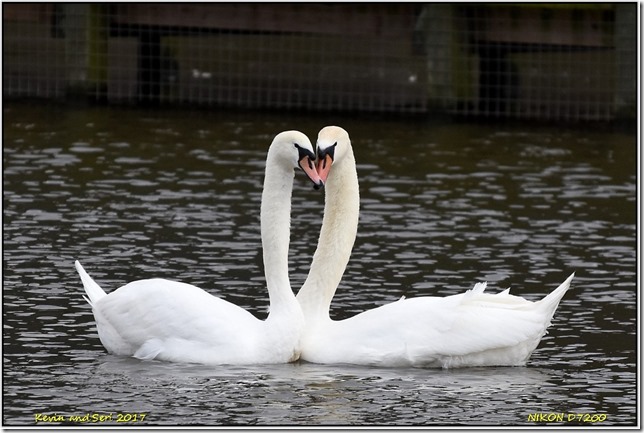
Slimbridge WWT - December

I ended February with the dreaded lurgy. Sad smile I was so proud that I didn’t catch anything so far when everyone around me was down with something. I coughed for Britain and I think I had woken up the neighbourhood with my persistent coughing. My nose was winning the running race. My constant companions were the hot water bottle, cough syrup, boxes of tissues, Vicks vapour rub and Paracetamol. I took 3 days off work to recover and rest. Resting had allowed the body to focus all of its energy on overcoming the virus.

Brandon Marsh - February

Thursday, 13 April 2017

Waxwing Winter


February was the soul’s month, the month of whispered hopes where we turned our expectant faces towards the promises of the warmer months to come. But first, we welcomed the month with a yellow warning from the Met Office of 70 mph winds over Warwickshire. The icy conditions of January had made way for strong winds and heavy downpours. Then flurries of snow arrived as temperatures began to plunged. Still, no snowman as the white stuff refused to settle in Coventry.Sad smile

Brandon Marsh - February

But whatever the weather, we zipped up warm and ventured out. First on our list, was renewing our membership with the Warwickshire Wildlife Trust. We waited for a break in the weather to check out what the natives were up to and whether they still remembered us. We’d a lovely surprise when we saw this handsome fella sunbathing on Goose Island.

Brandon Marsh - February

The male Goosander was striking with a clean white body, dark green head and a slender, serrated red bill. We looked around for the elegant grey-bodied female with rich, cinnamon head and a short, crest but she was nowhere to be seen. They were known as Merganser in North America and foraged by diving and swimming underwater, propelled by their feet, stroking with both feed in unison.

Brandon Marsh - February

Nearby we watched a pair of Moorhen’s courting behaviour. Contrary to most birds, females competed for males, engaged in female-female fighting and initiated courtship. The heaviest female vie for the smallest male that meant female weight and male size were negatively correlated. Courtship behaviours included bowing and open-wing displays with harsh ‘ticket-ticket-ticket’  calls. The female solicited copulation by performing an arch-bow display.

Brandon Marsh - February

We didn’t stay long because the weather had turned windy and we didn’t want to be caught out in the reserve. As we walked out, we saw this adorable Long-tailed tit waving us goodbye. Were it not for the long tail and the puffed-out plumage, this diminutive bird could claim from the Goldcrest the distinction of being Britain’s smallest bird. Then it flew off to join its family party roaming happily through the woods.

Brandon Marsh - February

This month too we began checking out a field near Coombe Abbey in Brinklow for hares. One of Brandon regulars, Greenman, had given us a vague description of the place. We parked our car by a farmer’s gate and scanned the huge fields. Babe spotted 3 brown hares feeding on the grass but they were too far away to photograph. We were hoping to see some courtship ritual taking place but they just kept on nibbling on the young shoots. We walked along the road hoping to get closer but the hedges were in the way. Loud calls from this Great Spotted Woodpecker kept us company.

Brandon Marsh - February

I was also looking for sightings of Waxwings around Coventry. There were sightings all over the UK but not here. Waxwings were small startling-sized birds with prominent cress and colourful markings. They only flew here from Siberia and northern Scandinavia when they experienced a harsh winter or if there was food shortage. So many had been spotted that the RSPB described the month as a ‘Waxwing Winter’.

Brandon Marsh - February

They were traditionally said to herald the onset of icy weather, so the arrival of unusually high numbers suggested a cold spell ahead. They had appeared all along the east coast of Scotland and England, and had been moving steadily south and west in search of food. Their arrival had been classed as an ‘irruption’ to signify a large-scale arrival of a bird not normally found here.

Brandon Marsh - February

These plump, shaggy-crested birds, named because their red wing markings resembled wax seals, fed on berries. They had a distinctive appearance, with a mix of soft pinks and buffs, and splashes of bright yellow and red, topped off with a black ‘robber’s mask’ and a punk-like crest. Each bird was capable of devouring 390 berries, roughly their own weight, in two and half hours.

Brandon Marsh - February

Irruptions, or ‘invasions’ were prompted by failures of berry trees in Scandinavia. Typically, Waxwings arrived in eastern Britain, stripped trees and bushes such as rowan, hawthorn and elder of their berries, then moved on in search of more berries. On the continent, these mysterious irruptions used to prompt superstition and fear. They were named ‘plague birds’ because their visits were said to coincide with epidemics. Here, large numbers had traditionally been linked to a cold, hard winter.

Brandon Marsh - February

Although Coventry and Warwickshire didn’t experience any cold, hard winter, there were plenty of sightings of these enigmatic birds. I kept an eye on Twitter for local sightings and we checked out the location as soon as it saw it. The first place we went was at the village of Wolson near Rugby. Unfortunately, when we arrived about 2 hours later, they’d already stripped the berries in the area. But, they did return back in the evening. Sad smile

Brandon Marsh - February

The 2nd time was at our local haunt. I was at work and asked Babe to get me during my lunch break and we drove straight to Brandon Marsh. Again, we missed them. To overcome my frustration, we treated ourselves to hot chocolate and sat by the window of the cafe. A handsome Nuthatch entertained us with his feeding antics while I drowned my sorrows.

Brandon Marsh - February

In the nearby bushes, flocks of streaky-brown Reed Buntings were flying in and out to feed. The males had black heads and black throats, with a white collar and white moustache. They were some of the most ’adulterous’ birds on record. Over half the chicks in a nest might not been fathered by the female’s mate!!! After finishing our delicious drink, Babe drove me back to work.

Brandon Marsh - February

On the weekend, there was another sighting again at Brandon. It was now or never. As soon as we drove through the gate, I kept my eyes peeled on the trees that lined the road. And there they were, flying in and out of the bushes. We immediately parked the car and Babe went out with camera blazing. I stayed in the car grinning like a Cheshire cat. All you could hear were our cameras rattling away. They were busy stripping the last of the elder berries and wasn’t at all concern about the cameras.

Brandon Marsh - February

When I looked behind our car, there were at least a dozen cars parked behind us. Everyone was out with their cameras and binoculars. What a treat. It was like Xmas all over again. I think we were there for nearly an hour photographing about half a dozen of the most long-awaited birds. After feeding, they perched regally on top of the trees looking down at their loyal subjects. It was simply fabulous.

Brandon Marsh - February

I was quite reluctant to leave but we’d our fill and must let others to have a chance. It was quite misty in the reserve. More than a dozen Cormorants were basking on the main island  outside Baldwin Hide. They were large and conspicuous water-birds with an almost primitive appearance with their long necks making them almost reptilian. A pair swam towards the hide. There was a hint of dinosaur about the cormorants with wing feathers like scales, startling emerald eyes, agitated head movements, and the confident demeanour of a consummate predator.

Brandon Marsh - February

Then we trooped over to East Marsh Hide. The lone drake Goosander was low in the water, bobbing away on small waves. I do hope that this spectacular, shy, tree-hole nesting duck finds a partner to keep him company. Suddenly, with an arch of his long neck, he dived and was gone. A Buzzard flew in and landed on a branch on the opposite bank and kept us company.

Brandon Marsh - February

Buzzards used 3 main hunting techniques. They might locate prey from a perch and then flew directly to it. They soared over open terrain, hanging in the wind before dropping on to the prey and continued the attack on the ground. Alternatively, like this handsome bird, walked and stood on the ground looking for invertebrates. Then he flew back to the perch and started the same procedure. I think this must be its hunting perch which would be defended from other birds.

Brandon Marsh - February

We didn’t stay long because we wanted to check out our new playground for the hares. We parked the car at the usual place and scanned the fields. Unfortunately, the mist was coming down and we couldn’t see anything. Nearby, Babe spotted a pair of Red-legged partridge feeding among the stumps of the sugar beets. Although visibility was very bad, we could see the distinctive barred flanks, red legs and rufous chest. These handsome birds were sometimes known as the French partridge as they were introduced to Britain from the French.

Brinklow - February

February was also the month for love. The poet Chaucer in the middle ages was the first person to link St Valentine with romantic love. This was the beginning of the tradition of courtly love, a ritual of expressing love and admiration, usually in secret. Now, Valentine’s Day was associated with romantic love, and a marketing dream where millions of soppy cards were exchanged. Gifts of flowers, especially red roses, were sent with romantic messages and couples spent special time together over very expensive candle-lit dinners. Don’t forget the chocolates, teddy bears, perfumes and jewellery. It must be hard on someone who was still single.

Brandon Marsh - February

I took the day off to spend the day with Babe. After exchanging soppy cards and gifts, we made our way to our favourite place to spend the days with our favourite birds. The cafe had a special Valentine meal on and I dared not check on how much it was going to cost. But it was popular because it was fully booked. At first we’d the Baldwin Hide to ourselves and watched a heron fishing.

Brandon Marsh - February

Then, it began to fill up and was a bit noisy that none of the waders swam closer to the hide. We just sat at our favourite corner and scanned the surroundings. The Buzzard was back at its perch and hunting on the ground. A solitary Muntjac feeding contently on the opposite bank, before disappearing back into the undergrowth.

Brandon Marsh - February

After about an hour, everyone began to leave and the hide was quiet again. The Great Crested Grebe, Tufted ducks, Golden eye, Cormorants, Goosander and Pochards started swimming closer to the hide. A lightning flash of azure and a shrill call from the Kingfisher zoomed past before it disappeared into the undergrowth.  All you could hear were our cameras rattling away. We just don’t know where to point  because so many things happened at once.

Brandon Marsh - February

The piece de resistance was when a Little Egret flew in and landed on Goose Island. We held our breadth and watched it feeding.  It fed by walking through the water, stabbing left and right for small fishes, frogs and aquatic insects. Sometimes, it ran and agitated the shallow water with its feet to disturb the prey. It was highly dependant on visual cues when hunting and its feeding was highly affected if the water wasn’t clear.

Brandon Marsh - February

The Little Egret stood out well with its pure white plumage, elongated, sinuous long neck, attractive plumes on crest, back and chest. The legs and bill were dark but the feet was bright yellow. They were usually solitary except when roosting in trees or flying to roost. They were also known as the Lesser Egret.

Brandon Marsh - February

Trust not too much in whiteness as a symbol

for who can tell when foulness frames the bridal gown

or when smirched mind hides behind laundered wimple?

Brandon Marsh - February

As for th' untrammelled snows, so beautiful,

likely they're scheming how they might remove your toes,

perhaps even peck off your precious nose.

Brandon Marsh - February

Consider now the Egret how pure and innocent she seems,

dropping on angel wings from a heavenly sky

to stab to death every last thing that moves beneath her bright eye

~Wayland Wordsmith ‘Consider now the Egret’~

Brandon Marsh - February

On the way back to the car, we took a different route through the forest. keeping our eyes on the fallen wood. And there it was flushing in clusters on the moss-covered tree trunks. These crimson, red goblet shaped fungi was the Scarlet Elf Cup which were fairly common in humus, rich damp deciduous wood. It was one of a handful of mushroom to be found during the coldest time of the year.

Brandon Marsh - February

It was also time to check Ashlawn Cutting to see if the boys were back. The Conservation work parties had done so much for this nature reserve. The zig-zag path down to the reserve had been improved and the place had been tidied of shrubs and brambles with hedging along the way. Unfortunately, this place was littered with dogs poo that we’d to keep our eyes peeled on the ground to avoid stepping on them. Grr…..

Ashlawn Cutting - February

Along the way, clumps of snowdrops popped under the tangled brambles. One of their country names was ‘Fair Maids of February’ and they were also known as ‘Candlemas Bells.’ They were out in time for Imbolc and for Candlemas. Imbolc was the Celtic pagan cross-quarter day, halfway between the winter solstice and the spring equinox. Seeing these little white flowers, heralded the approach of spring, bringing hope to the heart and consolation at the end of a cold, grey winter.

Ashlawn Cutting - February

We continued on down the steep sided disused railway cutting with its very, wet and muddy path. The reserve was awashed with bird songs from Goldfinches, Robins, Blackbirds, Great, Blue and Long-tailed tits.  Under Ashlawn bridge, we found only one clump of frog spawn. We searched high and low for the boys but no body was home, We met a few of the volunteers and had a nice long chat. We hoped to come here every week to see the boys again.

Ashlawn Cutting - February

February ended with a visit from Storm Doris that moved across the UK bringing gusts of up to 94 mph accompanied by heavy snowfall across Scotland. The Met Office issued yellow and amber warnings for wind, snow and rain. Overnight and into the morning, the Storm underwent explosive cyclogenesis labelling it a weather bomb.

Shots from Home - February

We checked out our favourite playground after the storm was over. We heard that the storm had caused a number of issues with several trees coming down in the gale. One in particular, was our favourite tree at Carlton Hide. It was an ancient Field Maple, reputedly to be one of the oldest in Warwickshire. Half of the tree had split and collapsed. The conservation team had done a good job of clearing the path.

Brandon Marsh - February 

We also stopped at Baldwin Hide to check on our feathered friends. They didn’t seemed too bothered with what was happening after the storm was over. The Pochard, Tufted ducks, Cormorant and the Golden Eye swam quite close to the hide. Againl, a lightning flash of azure whizzed past us before it disappeared into the undergrowth. Earlier this week, Babe managed to photograph it perched on its favourite stump.

Brandon Marsh - February

On Goose island, a Great Crested Grebe was surveying the area for potential nesting site. I hoped it wouldn’t choose the island because it was in a very vulnerable location. Usually, the nest was either a hidden mound of reeds and other vegetation or a floating platform anchored to vegetation. Compared with other waders, they were limited in their choice of nesting sites, largely because of their physical specialisation as a highly efficient diver. 

Brandon Marsh - February

On land, it lost its grandeur, walking clumsy because its feet were placed so far back on its body. The feet was very poorly adapted for walking on land. It waddled with great difficulty and seemed to drag itself around on its belly. This was because for maximum efficiency and thrust in the water, the legs and feet were positioned as far back on its body as could be. After about 15 minutes, it made its way into the water to join its partner.

Brandon Marsh - February

We were hoping for a water ballet performance but not today. They were content to be swimming around the lake and if they were separated calls could be heard. For such elegant birds, they possessed the most inelegant repertoire of sounds ranging from guttural grunts, to loud squawks and honks like a goose, to rolling growling noises. Fingers-crossed, they will be able to find a favourable nesting site to start a family.

Brandon Marsh - February

‘Grebes run on the lake

love has its playful moments

pleasure with winged feet’

~David De la Croes~

Brandon Marsh - February

We then made a pit stop at East Marsh Hide. On the main island, Wigeons were having a snooze after a full day grazing on the grass banks. A pair of Oystercatcher flew in with their distinctive and shrill, piping ‘kleep, kleep calls. We watched them performing piping displays, running together side by side, calling loudly. Then the female adopted a stiff, stationary posture, bending forward with legs straight, neck drawn in, bill horizontal, and tail elevated. The male mount, briefly waving wings, calling and pecking at female’s head, then lowered himself onto tarsi. It only lasted a few seconds.

Brandon Marsh - February

After that x-rated displaySmile, we left them and walked through the forest to cool down. We spotted more Scarlet Elf Cups along the way. We made a pit stop at Steely Hide but nobody was home. We spotted a Buzzard but it was too far away to photograph. Since everything was winding down for another cold night, we said bonne nuit to our feathered friends and made our way home.

And lastly came cold February, sitting
In an old wagon, for he could not ride,

Brandon Marsh - February
Drawn of two fishes, for the season fitting,
Which through the flood before did softly slide

Brandon Marsh - February
And swim away: yet had he by his side
His plough and harness fit to till the ground,

Brandon Marsh - February
And tools to prune the trees, before the pride
Of hasting Prime did make them burgeon round.

Brandon Marsh - February
So passed the twelve months forth, and their due places found.

~Edmund Spenser, ‘The Faerie Queen~

Brandon Marsh - February